Assisted Living vs In-Home Care Costs in Columbia, Missouri
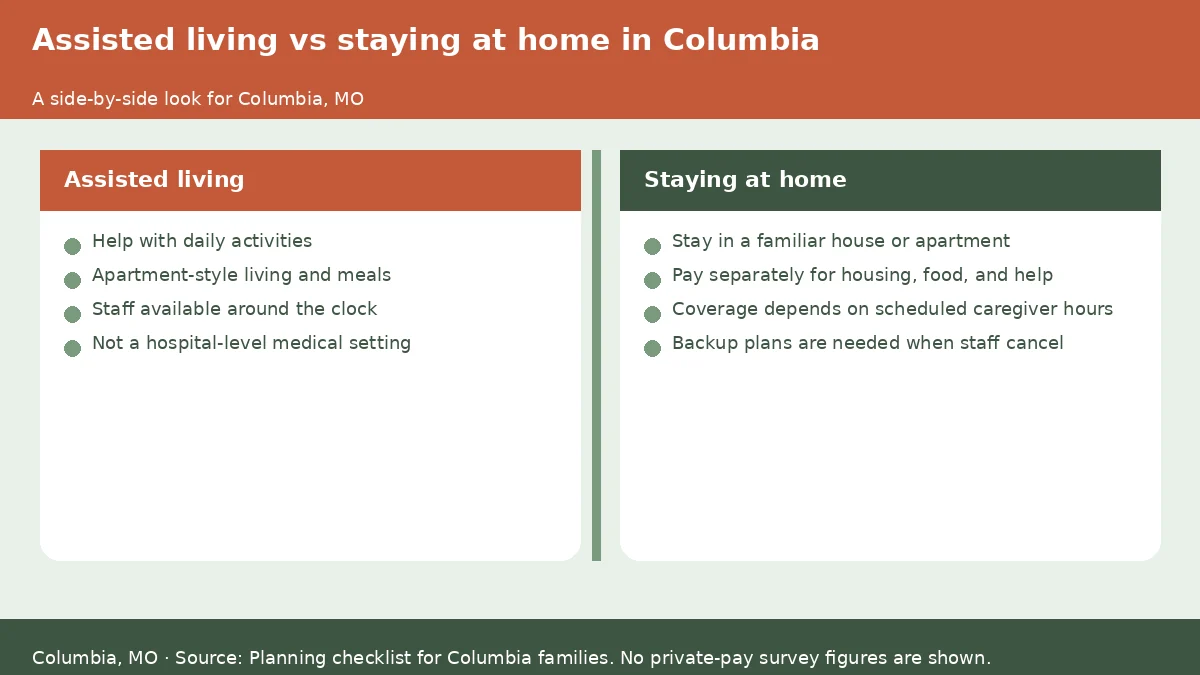
A fair comparison between assisted living and staying at home in Columbia should include housing, food, utilities, transportation, backup coverage, and unpaid family caregiving—not only an hourly caregiver rate. Ask agencies and communities for written estimates based on the hours and help actually needed.
Medicare does not pay for room, board, or ongoing custodial care in assisted living if that is the only care someone needs (Medicare.gov: long-term care coverage).
Eligible wartime Veterans and surviving spouses can review VA pension with Aid and Attendance. As of December 1, 2025, the maximum annual pension rate with Aid and Attendance is $29,093 for a Veteran with no dependents and $34,488 for a Veteran with one dependent (current VA pension rates). A surviving spouse’s Aid and Attendance maximum is $18,697 a year with no dependent children (VA Survivors Pension rates). These are benefit limits, not the price of a Columbia community. The net worth limit for these pensions is $163,699 from December 1, 2025, through November 30, 2026.
For local public-benefit counseling, start with the federal Eldercare Locator at 1-800-677-1116, which connects families to the Area Agency on Aging that serves Columbia, Missouri.
Most older adults would prefer to stay in their own homes, and for many that is the right choice for a long time. But as needs grow, families in Columbia often find themselves comparing the cost of hiring help at home with the cost of moving to assisted living. The answer depends heavily on how many hours of help are needed.
The 2025 numbers for Columbia
That is a substantial amount of help, but it still leaves most of the day and all of the night without paid support.
How costs change with hours of help
Actual agency rates, minimum shift lengths, and weekend or overnight rates will vary.
These are simple multiplications of the survey's hourly median, shown only to illustrate scale. They are not quotes.
The pattern is clear. For a few hours of help a week, in-home care is far less expensive than assisted living. At around 40 to 45 hours a week, the costs in Columbia are roughly equal. Beyond that, in-home care becomes more expensive, and round-the-clock care at home costs several times as much as assisted living.
Costs on top of in-home care
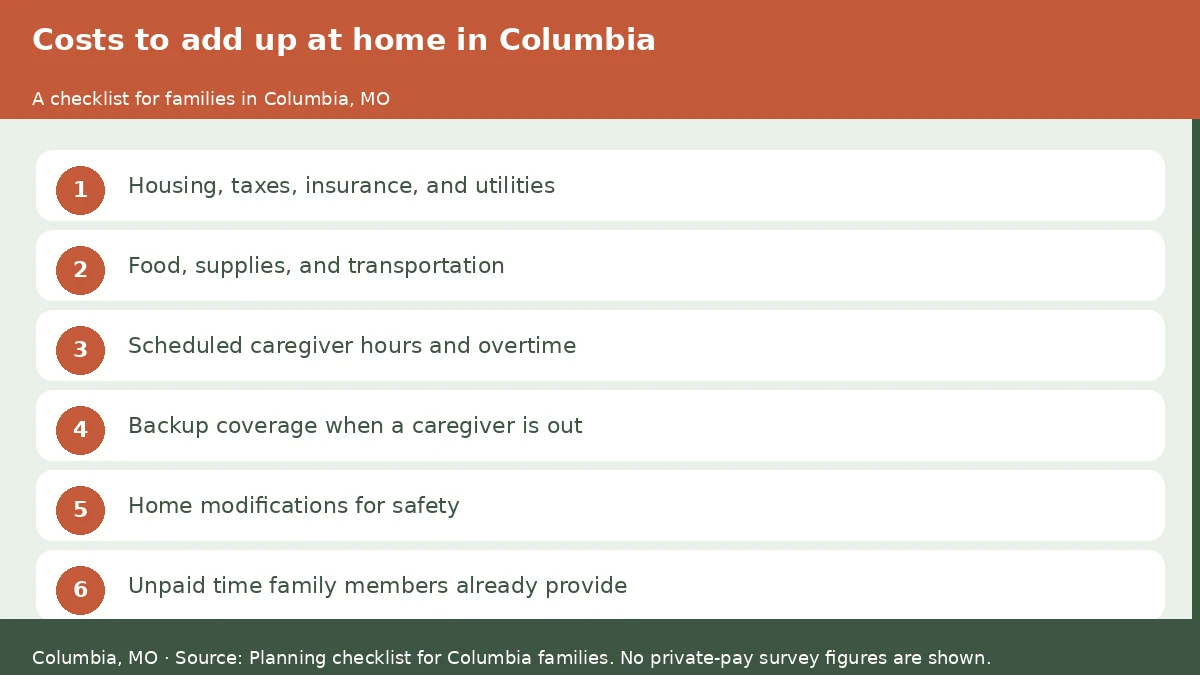
The hourly rate is not the only cost of staying home. Families often forget to count:
- Housing. Mortgage or rent, property taxes, insurance, and repairs continue.
- Utilities. Electricity, gas, water, internet, and phone.
- Food. Groceries and any meal delivery.
- Home modifications. Grab bars, ramps, stair lifts, or a bathroom remodel.
- Transportation. Trips to appointments around Columbia, whether by family, taxi, or paid service.
- Supplies and equipment. Incontinence products, monitoring devices, or a medical alert system.
- Family time. Hours of unpaid care filling the gaps, often at the cost of work and health.
Assisted living rates generally include housing, utilities, meals, housekeeping, activities, and some level of personal care, though what is bundled varies from community to community. When you compare, add up everything your parent spends to live at home now, not just the home care bill.
What Medicare does and does not cover
Medicare can cover part-time skilled home health care, such as nursing or therapy, for people who are homebound and meet other conditions. It does not cover ongoing custodial help with daily activities such as bathing and dressing when that is the only care needed, and it does not pay for assisted living (Medicare.gov, home health services). Most families pay for non-medical home care and assisted living privately, with help in some cases from long-term care insurance, VA benefits, or Missouri programs. Our guide to paying for assisted living in Missouri covers those options.
Beyond cost: what each option offers
In-home care may be the better fit when
- Your parent needs help for a limited number of hours a day
- Nights are safe and uneventful
- Family members live nearby and can fill gaps
- The home is safe or can be adapted affordably
- Your parent strongly wants to stay and is not isolated
Assisted living may be the better fit when
- Help is needed at unpredictable times, including at night
- Falls, wandering, or medication problems are a concern
- Your parent is lonely or no longer leaves the house much
- Family caregivers are exhausted or live far away
- Home care hours keep creeping upward
The question of supervision
One difference that does not show up in a cost table is supervision. With home care, help is present only during scheduled hours. In assisted living, staff are on site around the clock, and someone notices if a resident does not come to breakfast. For a parent who has fallen, who wanders, or who becomes confused at night, that constant presence may matter more than the price comparison.
Socialization and daily rhythm
Loneliness is a real health concern for older adults. At home, a parent may see only a caregiver and occasional visitors. In assisted living, there are shared meals, activities, and neighbors. Some people treasure their solitude; others come alive with company. Consider your parent's personality honestly.
A middle path
Some Columbia families combine approaches. A parent might stay home with a few hours of help a week, add adult day services, or use a short respite stay in assisted living while a family caregiver travels or recovers from surgery. A short stay can also serve as a trial, letting everyone see whether community living suits your parent. Our article on respite care in Columbia explains how that works.
How to run your own comparison
- Estimate the hours of help your parent needs now, and how that may change in a year.
- Get quotes from two home care agencies, including minimum shifts and night rates.
- Get written quotes from two or three assisted living communities.
- Add up all current household costs.
- Compare totals, then weigh safety, company, and family strain alongside the numbers.
Talk with Hillcrest
Hillcrest Assisted Living, at 9415 N Brown Station Road in north Columbia, is happy to help you compare. Call (573) 873-0761 to request current pricing, see our pricing page for what affects a quote, or plan a visit.
Frequently asked questions
Is in-home care cheaper than assisted living in Columbia, MO?
For part-time help, yes.
How much does 24-hour home care cost in Columbia?
Actual quotes vary.
Does Medicare pay for in-home care?
Medicare covers part-time skilled home health care for homebound people who qualify. It does not cover ongoing personal care alone or assisted living.
What costs do families forget when comparing?
Housing, utilities, food, home modifications, transportation, supplies, and the unpaid time family caregivers contribute.